
Hockey Protective Gear We Wear

If you’ve ever wondered about the hockey protective equipment that players strap on before games, this is your guide.
This page is for people who know little to nothing about hockey and are interested in the different types of proper safety equipment for hockey.
Also below I’ll share some valuable tips on how to choose the best hockey gear in each area needed.
Protective hockey equipment is not cheap, and returning slightly-used smelly gear is rarely an option. So choosing the right gear is important.
In the 2021-2022 season, there were over 551,000 registered ice hockey players in the United States alone. The number of unregistered iced hockey players likely dwarfs that figure.
Need some equipment? Perani’s is a great choice. Check out my Perani’s Hockey World review to learn why.
9 Types of Hockey Protective Equipment
There are nine primary areas of our protective safety equipment that hockey players use to avoid injuries that occur from collisions with other players and the boards, pucks, sticks, and of course the ice.
We’ll examine all nine below from top to bottom.
1. Helmets
The most crucial element of our protective equipment is by far our helmet.
Hockey helmet technology has come a long way in the past 50 years.
When I was playing in the mites and squirt leagues in the 1970’s we wore simple molded plastic helmets without any facial protection.

Back then, lacerations to the unprotected face were so common that often a coach or trainer would stitch up cuts while the player remained on the bench between shifts.
Hey, hockey players are tough!
Concussions were more frequent too until the invention of the game-changing “Patterson Helmet” by General Electric. It was made of a synthetic material called Lexan and had a suspension design that kept the head safely cradled away from the outside shell.
Today’s hockey helmets, still using the Patterson model, are stronger and lighter since they use even sturdier composite materials. The padding inside has also improved to protect us from head injuries and concussions.
Youth through college-level players are required to wear full facial protection now which can either be a helmet wire cage, plastic visor (clear shield), or a combination of the two.
Pros and beer leaguers usually have a choice of whether to use facial protection or not.
But a helmet is always required.
1A. Mouth Guards
I have grouped hockey mouthguards with helmets since I consider our head and teeth a package deal.
Obviously, hockey players are notorious for missing teeth.
Mouthguards are a heck of a lot cheaper than dental bills.
But even with full head and face protection, you can still get teeth knocked out when you’re not wearing a mouthguard.
2. Shoulder Pads
Shoulder pads, like helmets, have also improved dramatically over the past several decades.
Hockey shoulder pads in the past were made of leather and plastics. Today, they are made of flexible fabrics and composite plastics that are tougher and lighter.
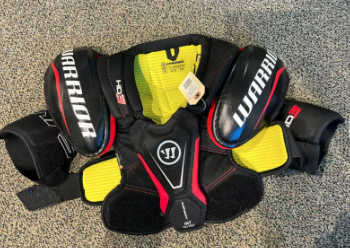
Hockey shoulder pads mostly protect the shoulder and chest area with a lighter area of protection for the back.
Shoulder pads are necessary for full-contact checking leagues to prevent injuries to the clavicle and other shoulder areas.
In the beer hockey leagues, there is no checking allowed so shoulder pads are optional.
But even in beer hockey, shoulder pads are a good idea since we sometimes fall to the ice or crash into the boards.
3. Elbow Pads
Elbow pads are crucial to hockey players at all levels since when we fall or get knocked down we nearly always crack at least one elbow on the ice.
And that ice is damn hard.

Elbow pads are made out of light-weight flexible fabrics and usually have a large composite shell directly over the elbow bone.
4. Gloves
Gloves are an interesting piece of hockey protective gear because they not only protect the hands and wrist but are an extension of hockey shots and stickhandling.
Hockey gloves in the past were made out of leather and had a palm area made out of horsehide. They were durable but heavy and cumbersome.
Modern gloves are made of a combination of synthetic leather, nylon, and polyester. The synthetic leather palm areas give players a nice stick feel but do not last as long as the old horsehide.

Most hockey players are picky about their gloves because they want maximum hand protection, but not at the expense of limiting hand mobility.
To be an effective stick handler and shooter, you need to have a glove that doesn’t limit the feel between your hand and your stick.
5. Pants
Hockey pants, also referred to as breezers, are more than just another part of our uniform.
Those pants are heavily padded in the rear for when we fall on the ice on our ass and padded in the front and side for when we block shots.
In addition to tailbone padding, they also protect kidneys, hips, and thighs.
Modern hockey pants are lighter and more flexible than ever which helps our mobility to skate freely.

6. Cup
A hockey cup is secured by a jockstrap or hockey jock shorts combination (most common today) and protects the male anatomy.
If you play hockey and plan on having kids, a cup is pretty much a necessity.
Even wearing up a cup, getting hit in the nuts with a stick or puck hurts like hell.
The hockey cup works well for protection but is not 100% effective since it does slide around at times leading to elements of the male anatomy wandering out of its hard plastic shell.
